The internal conflict navigating Korean social expectation while being in an intercultural relationship
This morning as I was brewing a cup of coffee in my Amsterdam apartment, I unconsciously began to think about my old friends from South Korea that popped up in my Instagram feed. I know I shouldn’t be scrolling the first thing in the morning, but I used jetlag from my recent trip back from home to give myself a pass.
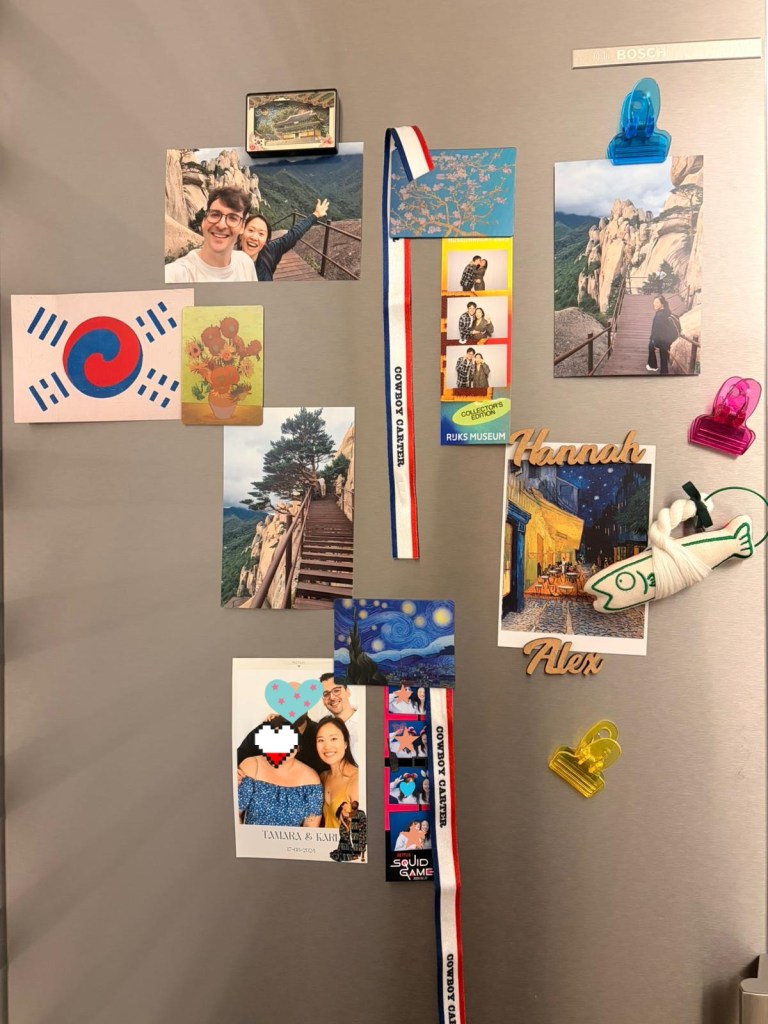
As I let myself daydream on and on about the friends and what life they have built since I last saw them, the decorations my boyfriend and I made on the fridge door caught my eyes. There were Cowboy Carter bracelets I got from Beyonce concert last year in London, along with photos, magnets and postcards we collected from the recent trips.
Among the postcards was an old Korean flag that we bought at the national museum of South Korea, which was a flag used during the independent movement in the Japanese colonization period. Next to the postcard, was a photo of my Spanish boyfriend and myself at the peak of Seorak mountain with big grins in our faces, holding up our arms to the sky. It suddenly hit me that I was back in Europe, showcasing my souvenirs from Korea as if I was a tourist of my own country.
Somehow, that photo of us reconnected me back to a friend’s Instagram story. Last time I met her, she introduced me to her fiancé and told me she was in the process of preparing for her wedding. The Instagram story was photos of her parents and herself going to Sang-Gyun-Rae, a ceremony which is a formal meeting between the families of the bride and groom before the wedding takes place. It is a meal where both sides come together not only to greet each other, but to discuss practical matters like the wedding logistics, and financial expectations from each families to cover the costs of wedding and housing.
It is one of the most important steps leading to the success of a wedding. I DM’d her to ask how it went, as she had been nervous. Her sister’s wedding had once fallen apart after conflict during a similar meeting—an argument over housing that escalated beyond repair. Thankfully, she said the dinner went well. It seemed that her training of mom to not say anything controversial worked well.
I also remembered that she explained how since the father of her fiancé passed away, the sister replaced the father’s place at the table. It sounded as if it was a deficit that the father could not be there and someone had to compensate for the missing piece, like a missing player in a match where the number of players had to be even.
I began to wonder what it would have been like for me if I had to attend the Sang-Gyun-Rae with a Spanish fiancé and his family. I would be the bride with her mom without the father and the Spanish groom with the divorced parents.
Ever since I was dating my current boyfriend, my mom would say comments like,
“It is actually very nice that you met a Western boy because then we don’t have to worry about all the procedural bureaucracies that comes between Korean families.”
She meant that she was more free from being judged for being divorced because the social rule of bride having no father would not apply as strictly in this cross-cultural relationship. My South Korean mother’s biggest fear was her only daughter without a father, was going to be penalised and get kicked out of the game of marriage, because the “no-father” condition is a huge disadvantage for a bride where the end goal she was running towards is a happy wedding.
Growing up in different continents since at 12, I never felt that I fully belonged to the social norms of Korea. I believed I existed outside of the boundary where those rules applied. I was confident that this concept of keeping a scoresheet in family’s status is a complete load of crap and that I did not belong to the stereotype in this modern day and age. But as I got older and saw more relationships breaking off because of financial differences, I began to wonder if the “invisible social class” really exists. My confidence and belief started to shake.
It did not help that I also witnessed the invisible social classes in Europe, where the rule of the marriage game was about the status of family’s income and social class. In some areas of Europe, it seemed like people were getting married in similar “social group”, where families went to similar vacation spot, had similar retirement plan, similar price of the house and number of extra houses they owned. If the couple had similar family background, they would be playing the fair game where the audience could watch them in comfort. No disadvantage and no advantage given to either players.
The rules of this international game I have been denying was everywhere. It was a shocking realisation because it meant that I was at the bottom of the social pyramid, benched on the side line. My confidence and identity was withering as I was allowing this thought to take over my mind, but I had to hold on to the string of confidence and hope that it was not always true. I had to ask myself, ‘would I hold this standard against my friends?’ Thankfully my heart immediately answers ‘No’ without a second of hesitation.
Sometimes the outdated societal rules I dismiss catches up to me. Then I need to take a moment to really review what I have built for myself. Like the front door of my fridge, it is beautifully put together with handpicked selections of goods from all around the world. On the door, there was no photo or magnets symbolizing a woman without a father. It is full stories with pure joy, with people I chose to share them with.
I am not just a Korean girl with a single mother but a girl with a lot of things, scatters of a things, that make me a whole. Some people want to observe marriages as a game with players and want to see what jobs the parents have and what neighbourhood they grew up in and I don’t blame them. But how bad would it be if we look at the Olympic games and judge the players based on their ethnicity? Nevertheless we are talking about marriage where the importance is not to just make to the goal of marriage, but to finish the game with joy knowing that you made it with your effort and time overcoming many small and big moments of difficulties.
 Cultural Bibimbap
Leave a comment